
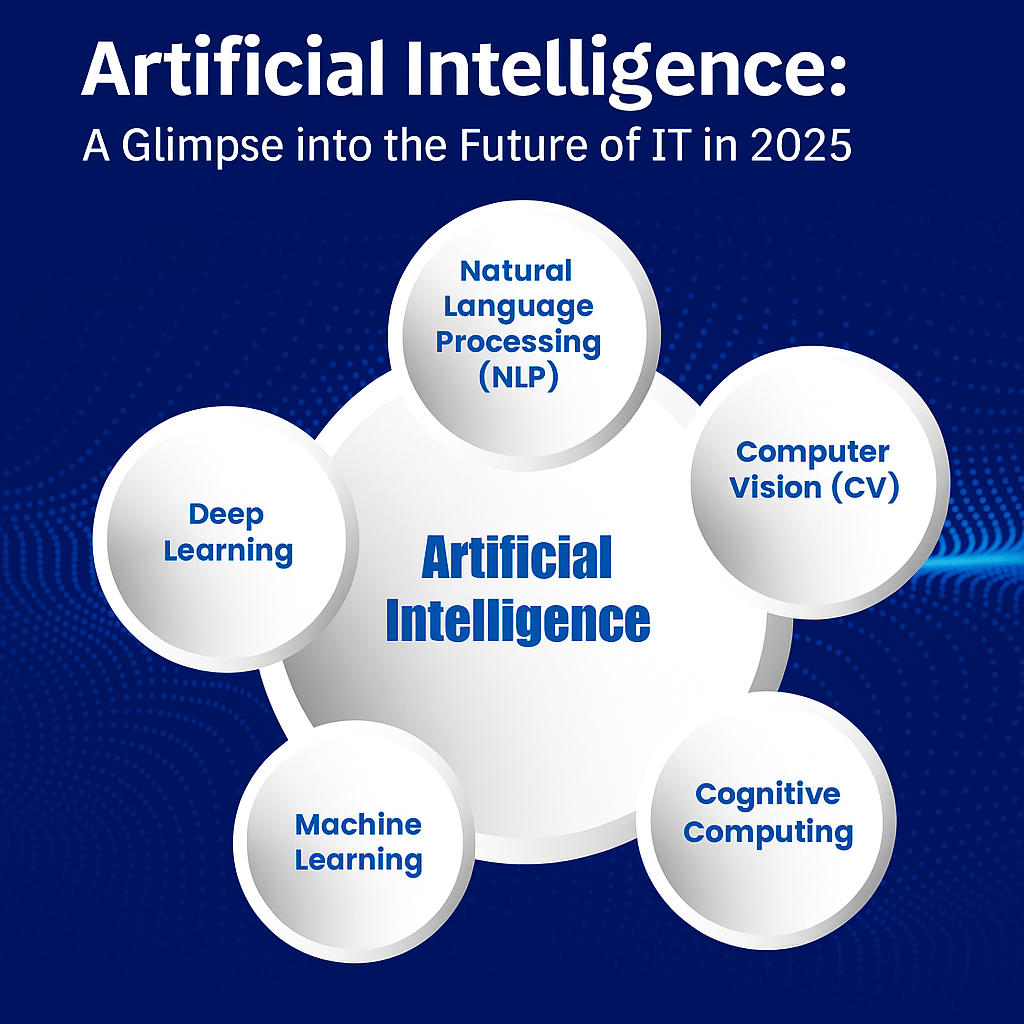
What Is Artificial Intelligence? A Look at the Future of Information Technology in 2025
Introduction
In recent years, Artificial Intelligence (AI) has become one of the most important buzzwords in the world of technology. From smartphones to enterprise systems and complex networks, AI can be found everywhere. However, in 2025, this technology is no longer just a helpful tool—it has become the beating heart of the IT world.
What Exactly Is Artificial Intelligence?
In simple terms, artificial intelligence refers to a computer system’s ability to mimic human mental processes such as learning, analyzing, decision-making, and problem-solving.
When a machine can learn from data and make decisions without direct human intervention, it is using AI. ML and DL are major subfields of AI that have driven its remarkable progress over the past decade.
Why Is AI Critical for Information Technology?
In the past, IT departments mainly focused on hardware and networking. But with the explosion of data and system complexity, the need for technologies capable of intelligent decision-making has grown significantly.
In 2025, AI plays a key role in automating processes, optimizing server performance, predicting system failures, and even assisting in software development.
Major Applications of AI in IT in 2025
-
Intelligent Automation of IT Processes
By 2025, many repetitive and time-consuming IT tasks will be handled by AI. Automated systems will detect server errors, generate reports, and even recommend optimizations. For example, in data centers, AI can reduce energy consumption and prevent potential failures.
-
Predicting and Preventing Cyberattacks
Cybersecurity remains one of the biggest challenges in the digital world. AI can analyze user behavior, identify anomalies, and issue warnings before an attack occurs. In 2025, many companies will rely on AI-based systems for threat detection, smart encryption, and combating unknown malware.
-
Big Data Analysis
In large organizations, the volume of data has become so vast that manual processing is impossible. Using deep learning algorithms, AI can quickly extract valuable insights from massive datasets. With these analyses, IT managers can make more accurate and strategic decisions.
-
Improving User Experience (UX) and Intelligent Support
AI-powered chatbots and virtual assistants are no longer simple response tools. By 2025, they will be able to recognize user emotions, adjust conversational tone, and offer personalized recommendations—delivering faster, more precise, and more user-friendly IT services.
-
AI-Assisted Software Development
AI can help with code writing, error detection, and even UI design. In 2025, smart development tools will automate parts of programmers’ tasks, dramatically shortening product development time.
Challenges of Using AI in IT
- Lack of high-quality data for model training
- Ethical and privacy issues in user data analysis
- The need for new skills among IT professionals
- The risk of excessive dependency on automated systems
The Future of AI in IT
The world is on the brink of an era where intelligent systems will no longer just assist humans—they will become real decision-makers. From cloud infrastructure to security and software, no area of IT will remain untouched by AI’s influence. Organizations that adopt this technology earlier will gain a decisive advantage in the competitive future ahead.