
- Home
- »
- FaraNet Project – Passive Network – Tehran
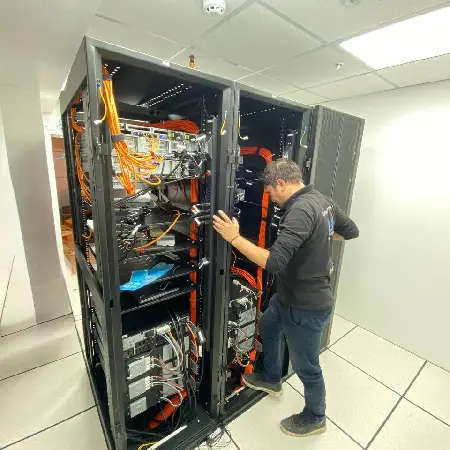
FaraNet Project – Passive Network – Tehran
Province: Tehran
Year of Execution: 2015
Deployment Phases Network Infrastructure
Phase 1 – Planning & Design
-
Collect client and end-user requirements
-
Conduct site survey and environmental assessment
-
Design logical and physical topology diagrams
-
Define cable routes, rack positions, and access points
-
Select cabling standards (TIA/EIA, ISO/IEC)
-
Prepare layout drawings and technical documentation
Phase 2 – Infrastructure Preparation
-
Prepare the server room / data rack area
-
Install conduits, trays, ducts, and trunking systems
-
Verify power supply, grounding, and HVAC readiness
-
Ensure site safety and compliance with standards
Phase 3 – Passive Network Implementation
-
Perform horizontal and vertical cabling (Copper & Fiber)
-
Install patch panels, racks, and termination accessories
-
Label and document cable routes
-
Conduct certification tests (e.g., Fluke testing)
Phase 4 – Active Network Deployment
-
Install switches, routers, firewalls, and access points
-
Configure VLANs, IP addressing, and routing protocols
-
Test internal and external connectivity
-
Apply security configurations (ACLs, Firewall rules)
Phase 5 – Testing & Validation
-
Conduct end-to-end connectivity and performance testing
-
Validate latency, throughput, and redundancy
-
Check failover and recovery mechanisms
-
Resolve identified issues and finalize punch list
Phase 6 – Documentation & Handover
-
Prepare final As-Built drawings and documentation
-
Deliver all test reports, configurations, and manuals
-
Provide end-user training for operation and maintenance
-
Sign final acceptance certificate with the client
Phase 7 – Maintenance & Support (Optional)
-
Conduct periodic preventive maintenance
-
Monitor network performance and health
-
Provide troubleshooting and technical support